
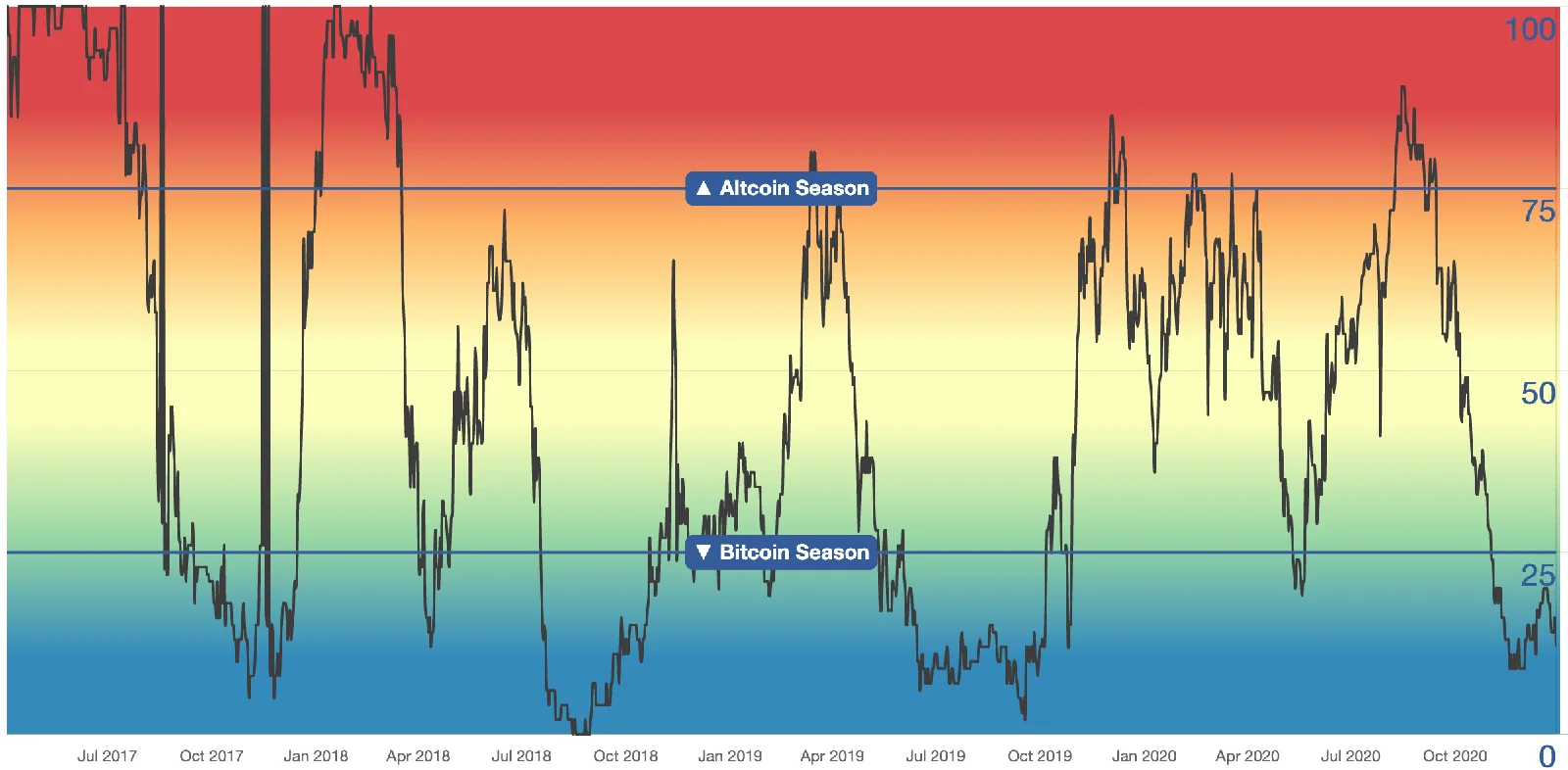
“Altseason” is the stretch of a crypto bull cycle when capital rotates away from Bitcoin and into the rest of the market—first into Ethereum, then into large-cap altcoins, and finally into mid/low caps and micro caps. Prices accelerate, correlations tighten, and market breadth widens. If you’ve heard traders say “banana zone,” they’re talking about the same late-cycle melt-up: a steep, almost comical curve higher on altcoin market-cap charts that looks like a bent banana.
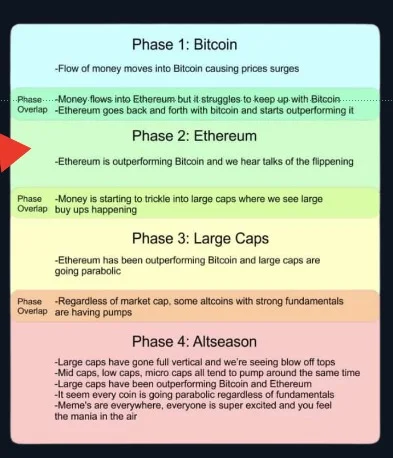
Below is a practical walk-through of the typical sequence, mapped to the four-phase infographic you referenced, plus a clear view of how TOTAL1, TOTAL2, and TOTAL3 tend to behave at each step.
The four-phase flow (from Bitcoin to “everything pumps”)
Phase 1: Bitcoin leads
- What happens: Liquidity concentrates in BTC. Macro headlines, institutional flows, or a spot ETF narrative often kick off this leg. Bitcoin’s dominance (the percentage of total crypto market cap sitting in BTC—often tracked as BTC.D) rises because BTC appreciates faster than the rest of the market.
- How it feels: Most alts lag or chop. ETH/BTC is soft. Social chatter centers on Bitcoin’s milestones (breakouts, halving, ETFs, “digital gold”).
- Market-cap lenses:
- TOTAL1 (the entire crypto market cap) trends up, driven mostly by BTC.
- TOTAL2 (market cap excluding BTC) rises, but sluggishly compared to TOTAL1.
- TOTAL3 (market cap excluding BTC and ETH) is flat to modestly positive.
Phase overlap 1 (BTC → ETH begins): Money starts to leak from BTC profits into ETH, but ETH initially struggles to keep up with Bitcoin. ETH/BTC bounces but remains in a range. TOTAL2 picks up, yet TOTAL1 still outperforms because BTC strength dominates.
Phase 2: Ethereum outperforms
- What happens: Narrative shifts from “BTC only” to “ETH is catching up” (scaling upgrades, fees, restaking, L2 activity, NFTs coming back—whatever the catalyst). Traders talk about the “flippening” again. ETH/BTC breaks out or shows persistent higher lows.
- How it feels: Large-cap alts perk up. Liquidity broadens. Gas fees sometimes rise on Ethereum as on-chain activity returns.
- Market-cap lenses:
- TOTAL1 keeps rising.
- TOTAL2 accelerates relative to TOTAL1 (a sign that alts as a group are starting to lead).
- TOTAL3 begins to form a base; not exciting yet, but it’s no longer dead money.
Phase overlap 2 (ETH → large caps): While ETH leads, capital trickles into other large caps—think L1s and older DeFi majors. You start seeing outsized green candles in names that underperformed for months. Sector rotations appear: L1s one week, DeFi or scaling tokens the next.
Phase 3: Large caps go parabolic
- What happens: Ethereum has already outperformed. Now big, recognizable altcoins (top 20–50 by market cap) catch major momentum. Fund flows chase relative strength. Narratives multiply: AI tokens, gaming, RWA, L2s—choose your theme.
- How it feels: Many watchlists are suddenly green. Breakouts hold. Dips get bought fast. New retail interest returns because the number of winners increases.
- Market-cap lenses:
- TOTAL1 is strong but no longer purely BTC-driven.
- TOTAL2 often breaks key resistance/ATHs from the prior cycle—classic altseason tell.
- TOTAL3 starts to sprint as money moves beyond ETH into the broader alt complex.
Phase overlap 3 (large caps → selective small caps): Regardless of market cap, some smaller alts with clear catalysts or strong fundamentals begin to pump. This is not yet “everything” —more like the first sparks in micro-cap land.
Phase 4: Altseason proper (“banana zone” toward the end)
- What happens: Large caps go vertical and drag the rest of the market with them. Mid caps, low caps, and micro caps pump—often simultaneously. Sentiment turns euphoric. You see “altseason index” trackers peg to extreme readings; social feeds get loud; coins without clear fundamentals moon on momentum alone.
- How it feels: A rising tide lifts nearly all boats—until it doesn’t. Blow-off tops and swift retraces become common. This is typically where the banana zone appears on charts: a steep, curved advance with shallow pullbacks.
- Market-cap lenses:
- TOTAL1 soars because everything is lifting.
- TOTAL2 outpaces TOTAL1; ETH and alt baskets dominate upside.
- TOTAL3 often goes ballistic—this is the purest expression of altseason because it strips out BTC and ETH and shows how deeply the rally has spread.
Eventually, profits rotate back into BTC and ETH (or into stablecoins), volatility spikes, and the cycle cools.
The “banana zone” explained
Traders call it the banana zone because, on a log chart, the curve of an accelerating uptrend resembles a banana: price climbs within a broad parabolic channel, pullbacks are shallow, and each breakout begets the next. You’ll usually spot it on TOTAL2 and TOTAL3 during Phase 4:
- Characteristics
- Breakouts through multi-month resistance with expanding volume and breadth (many coins participating).
- BTC dominance trending down steadily—sometimes cascading lower—as capital spreads wider.
- ETH/BTC strength: ETH keeps outperforming or at least stays resilient during BTC dips.
- FOMO feedback loop: winners fund riskier bets; sector rotations speed up; new narratives emerge weekly.
- On-chain congestion on popular chains (rising fees, mempool backlogs) as speculative activity floods in.
- Why it matters
- Gains can be dramatic but fragile. The same reflexivity that sends prices up can unwind quickly when liquidity turns.
- It marks late-cycle conditions: strong momentum, weaker regard for fundamentals, and increasing correlation among alts.
Reading TOTAL1, TOTAL2, and TOTAL3 through the cycle
Definitions first:
- TOTAL1 = total crypto market cap (BTC + ETH + all alts).
- TOTAL2 = total market cap excluding BTC (ETH + all alts).
- TOTAL3 = total market cap excluding BTC and ETH (alts without the two leaders).
How they typically move:
- Early bull (Phase 1)
- TOTAL1 rises as BTC carries the market.
- TOTAL2 lags; the ratio TOTAL2/TOTAL1 shrinks or drifts sideways—proof the rally is BTC-led.
- TOTAL3 is sleepy; some coins may pop on idiosyncratic news but there’s no broad participation.
- Rotation to ETH (Phase 2)
- TOTAL2’s slope steepens.
- ETH/BTC leads; TOTAL2/TOTAL1 starts climbing—alts (as a group) are gaining share of the whole.
- TOTAL3 forms higher lows; risk is re-pricing but still selective.
- Large-cap surge (Phase 3)
- TOTAL2 often reclaims major levels from the last cycle.
- TOTAL3 follows and begins to outperform; TOTAL3/TOTAL2 rises, a tell that money is moving beyond ETH into the broader alt basket.
- Altseason peak (Phase 4)
- TOTAL3 can go vertical. When TOTAL3 makes new local or all-time highs faster than TOTAL2, you’re in deeper altseason waters.
- Meanwhile, BTC dominance breaks down. It’s common to see sharp intraday swings where BTC chops or dips while alts continue pushing higher—until the music stops.
Useful ratios and checks:
- TOTAL2 / TOTAL1 → gauges how much of the whole market is alt-driven. Rising ratio = altseason strengthening.
- TOTAL3 / TOTAL2 → measures how much the move has spread beyond ETH. A rising ratio = later-stage altseason.
- ETH/BTC → confirms if Ethereum is leading, often a precondition for sustained alt strength.
- BTC.D → when it trends down decisively, altseason is underway; when it reverses, risk can compress fast.
Practical signs of an approaching altseason
- BTC strength cools without breaking the entire market. Bitcoin consolidates after a run, but dips are bought and higher lows hold. Dominance stops climbing.
- ETH/BTC trend shifts up. A move through key moving averages or prior swing highs on ETH/BTC often precedes broader alt strength.
- TOTAL2 breaks out on volume. Especially powerful if it clears the last cycle’s supply zones.
- Improving market breadth. More tickers make new highs; sector rotation broadens; winners are no longer confined to a handful of names.
- Funding and OI heating but not overheated. Rising open interest with manageable funding suggests sustainable trend, while extreme positive funding and crowded longs can foreshadow squeezes.
- On-chain and social activity spike. Higher L2 transactions, rising DEX volumes, and surging search trends/social mentions often accompany the handoff from Phase 2 to Phase 3.
No single signal is perfect—watch for confluence across dominance, ETH/BTC, TOTAL2/TOTAL3, and breadth.
Strategy notes (not financial advice)
- Plan rotations, not all-in bets. The four-phase flow implies a staggered approach: BTC → ETH → large caps → selective small caps. Being early or late at each handoff affects results more than headline returns.
- Use risk tiers.
- Tier 1: BTC/ETH—highest liquidity, lowest tail risk.
- Tier 2: Large-cap alts—higher beta but still liquid.
- Tier 3: Mid/low caps—highest upside, highest downside and slippage.
- Confirm with dominance and ratios. If TOTAL2/TOTAL1 is rolling over while you’re heavy in small caps, you may be fighting the tape. If TOTAL3/TOTAL2 is tearing higher, you’re in late-cycle conditions: tighten risk.
- Respect liquidity. In Phase 4, many names can air-pocket 20–40% on a single bad day. Use position sizing, avoid chasing illiquid candles, and pre-define exits.
- Accept that tops are messy. Banana-zone peaks rarely ring a bell. You’ll see failed breakouts, more violent mean reversion, and breadth deteriorating (fewer names making highs) while indices still look fine. That’s distribution.
A simple mental model for the whole dance
- Bitcoin sets the stage. When BTC is trending hard up, it absorbs new money and the market’s attention. Dominance rises, TOTAL1 outperforms the rest.
- Ethereum proves breadth. ETH outperformance says, “This is bigger than Bitcoin.” TOTAL2 starts to lead.
- Large caps confirm the cycle. The market shows structural strength as familiar blue-chips rip. TOTAL2 breaks out; TOTAL3 joins.
- Altseason erupts. The banana zone opens: TOTAL3 goes near-vertical, dominance falls, and even questionable coins moon.
- Gravity returns. Profits rotate back to BTC/ETH or stables, dominance stabilizes or bounces, and the cycle resets.
Quick checklist you can keep by your desk
- BTC in clear uptrend, then sideways/up while…
- ETH/BTC turns up → check.
- TOTAL2 breaks out with volume → check.
- Breadth improves across large caps → check.
- TOTAL3 accelerates; TOTAL3/TOTAL2 rising → late-cycle caution.
- BTC.D trending down throughout → confirms altseason.
- Funding, OI, and sentiment getting frothy? Start trimming risk.
Altseason is exciting because it compresses time: months of sideways action can translate into a few dizzying weeks of vertical moves. The infographic’s progression—Bitcoin → Ethereum → large caps → broad altseason—captures the rotation rhythm most traders experience. Pair that mental map with market-cap aggregates (TOTAL1, TOTAL2, TOTAL3), keep an eye on BTC dominance and ETH/BTC, and you’ll have a grounded, repeatable way to recognize when the banana zone is opening—and when it’s closing.
Is Altcoin Season Extinct? How Institutional Flows and Macro Forces Are Reshaping Crypto
For retail traders dreaming of an “altseason” — a phase where altcoins massively outperform Bitcoin — recent market dynamics have been frustrating. Bitcoin and Ethereum have continued to attract the bulk of capital and attention, while many smaller tokens lag behind or move sideways. But is altcoin season really dead, or simply evolving under new market forces?
Altcoin season, by definition, happens when non-Bitcoin coins outperform Bitcoin over a sustained period — typically measured by metrics showing a majority of altcoins rising more than BTC over 90 days.
1. The Institutional Shift: Big Money Likes Big Caps
A key reason altcoins aren’t rallying the way they did in 2017 or 2021 is institutional capital concentration. Over the past couple of years, massive inflows have poured into spot Bitcoin and Ethereum ETFs, which are now major anchors of institutional exposure.
These regulated products attract large, risk-averse investors — pensions, asset managers, and big funds — who prefer the liquidity and perceived safety of BTC and ETH over smaller, less liquid tokens. According to market analysts, Bitcoin ETF assets alone soared toward nearly $170 billion at peak inflows, led by flagship funds like BlackRock’s IBIT.
👉 What this means: more capital is parked in large caps, leaving altcoins relatively starved of deep, consistent liquidity.
2. Liquidity and Market Structure: Why Alts Struggle
Liquidity is the lifeblood of market rallies. BTC and ETH enjoy tighter spreads and deeper order books, partly underpinned by institutional participation and broader ETF trading. In contrast, many altcoins — especially smaller ones — have wider spreads and weaker depth, which makes large trades move prices unfavorably and deters big investors.
This structural imbalance dampens the kind of broad rotation that historically fueled dramatic altcoin seasons.
3. ETFs: Double-Edged Sword for Altcoins
There’s a growing narrative that altcoin ETFs could spark the next big leg for non-Bitcoin tokens. Analysts point out that early altcoin ETFs — focused on Solana, Cardano, XRP and others — are starting to attract meaningful flows, potentially outperforming BTC/ETH funds in some weeks.
These funds act as regulated entry points for professional capital and could eventually ease liquidity constraints and reduce volatility in broader altcoin markets.
However, they also concentrate capital into a handful of large alts. So while institutional flows into altcoin ETFs might strengthen top alt ecosystems, they don’t guarantee a broad-based altseason unless capital spreads wider across hundreds of tokens.
4. Market Maturity Is Changing Cycles
Traditional patterns where altcoins boom after Bitcoin’s peak are less reliable now. Institutional strategies and macro drivers are increasingly influential — meaning markets behave more like other financial assets than purely speculative crypto playgrounds.
A recent market report suggests the classic four-year cycle may no longer dominate price behavior, due to structural shifts including regulated products, macro liquidity conditions, and evolving trading frameworks.
This implies that altcoins may still rally — but not through the organic, speculative heat seen in prior cycles; instead, their moves might depend on capital rotation within the institutional framework.
5. Macro Play: Liquidity, Rates, and the Fed
Interest rates remain a potent force for risk assets. The Federal Reserve has cut rates several times through 2025, injecting liquidity that historically helps risk markets including crypto.
Lower rates typically push investors toward higher-return assets, which can be bullish for both Bitcoin and altcoins. But timing and impact aren’t uniform: Bitcoin — as the most liquid crypto — tends to absorb the initial bulk of capital flows.
If the Fed continues easing in early 2026 or a new Fed chair signals sustained dovish policy, liquidity might fuel further risk appetite — potentially extending beyond BTC into altcoins.
👉 Bottom line: macro liquidity could eventually spark renewed interest in altcoins — but the effect is gradual and dependent on how capital is allocated.
6. Will We Ever Get Alt Season Again?
Yes — but maybe not like old cycles.
Here’s why:
Signals that could point to an alt season
✔ Bitcoin dominance falling below critical thresholds, indicating capital rotation rather than concentration.
✔ Broad ETF and institutional flows into major alt ecosystems (not just BTC/ETH).
✔ Macro liquidity conditions (rate cuts, weak dollar) boosting risk assets.
✔ Derivatives, futures, and ETF mechanics creating momentum in alt markets.
Challenges that could delay or limit altseason
✘ Capital still heavily concentrated in BTC and ETH liquidity pools.
✘ Many altcoins lack the institutional interest or clear utility narratives.
✘ Regulatory and macro uncertainty can tighten risk appetite. (e.g., recent ETF outflows tied to fading rate-cut expectations)
So will we get an alt season? Probably — but it’ll be more structural and phased than explosive and retail-led. Instead of wild pumps driven by hype, expect rotations where institutional flows first strengthen major alt ecosystems (Solana, XRP, Cardano), then gradually extend to midcaps with real utility.
Final Take
Altseason isn’t dead — it’s just evolving. As crypto markets become entangled with traditional finance, macro policy, and institutional structures like ETFs, cycles are transforming. Big money is still chasing large caps first, but the edges of the market are reshaping. With the right combination of liquidity, macro support, and regulatory clarity, broader alt rallies are still possible — just not guaranteed or predictable on the old timelines.
Web-scale capital doesn’t “extinguish” altcoins — it reframes how and when altcoins can thrive.
If you’re positioning for the next phase, keep an eye on:
📌 ETF flows into alt ecosystems
📌 Bitcoin dominance metrics
📌 macro liquidity signals
📌 derivatives and futures funding trends
Altseason might just be smarter this time around — not gone.