
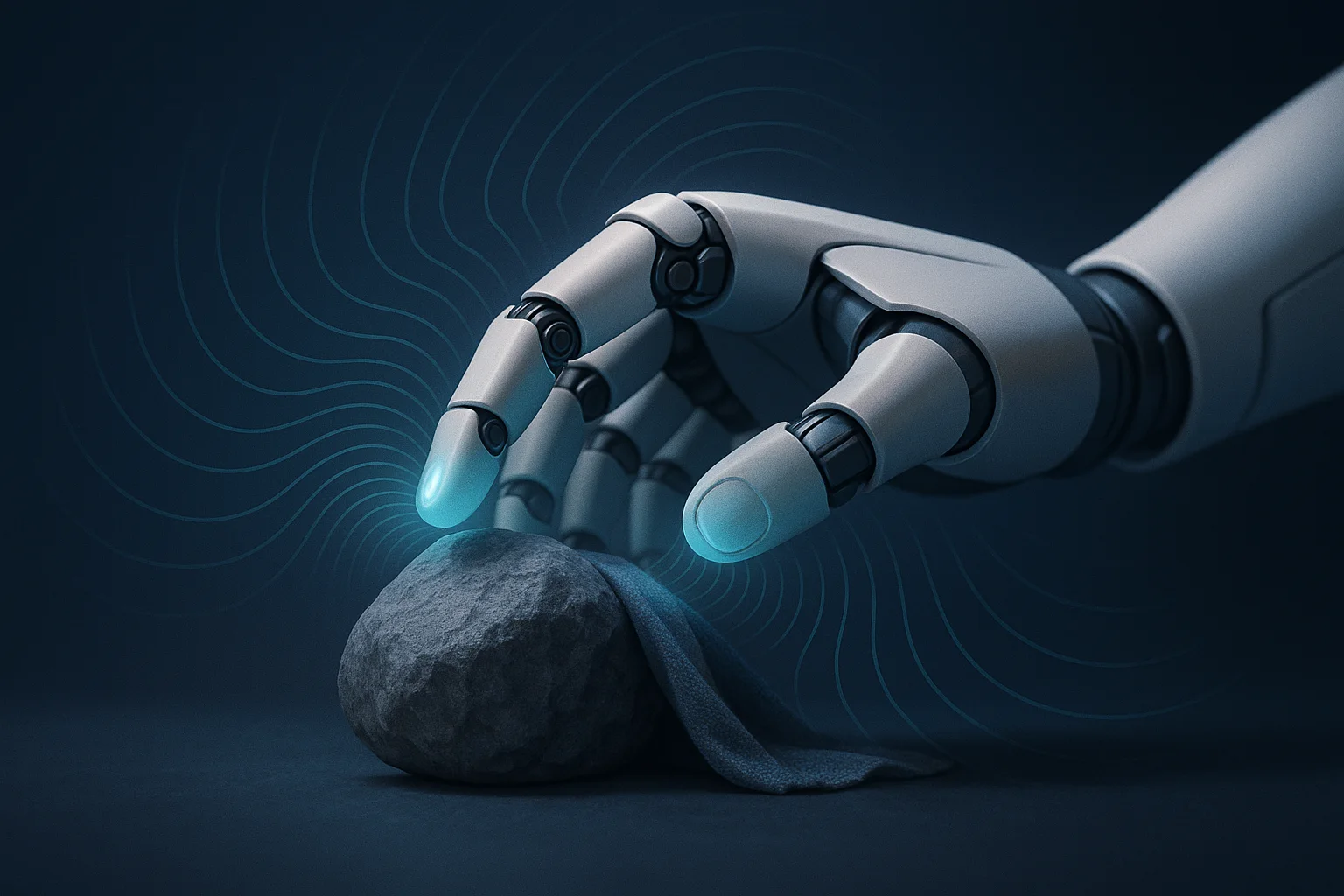
Look at your hand for a second. Without thinking, it can twist a bottle cap, tap a tiny button, or pick up a paperclip from the floor. This blend of strength, precision, and intuition is something robots have been chasing for decades—and still haven’t fully matched.
Why Human Hands Are Still the Gold Standard
Human hands are a kind of biological multi-tool. We can rotate objects, adjust our grip on the fly, and work with items so small that even cameras struggle to track them. Our nervous system constantly fuses what we see with what we feel—pressure, texture, slip, and position—creating a seamless feedback loop.
Robots, on the other hand, usually operate with a much narrower skillset. Many robotic grippers are designed for repetitive, predictable tasks: picking identical boxes off a conveyor belt, stacking items, or pressing uniform buttons. When the job gets messy, delicate, or highly varied, humans still take over.
The Core Problem: Robots Can’t Really “Feel”
Most robot hands suffer from three major limitations:
- Poor sense of touch: Many robotic grippers are basically strong claws. They might know how far a motor has turned, but not how softly they’re squeezing a fragile object.
- Limited coordinated movement: Moving several fingers at once in a smooth, natural way is still extremely hard for machines. What feels effortless to us is the result of incredibly complex motor control.
- Vision gets blocked: When a robot hand closes around an object, its own fingers can block the camera’s line of sight. Once the object is partially or fully occluded, the system may literally “lose track” of what it’s holding.
The result? Robot hands often drop things, crush delicate objects, or simply fail to grasp them in the first place. They don’t have the sensory richness we depend on every moment of the day.
A New Approach: Training the Robot’s “Brain,” Not Just Its Hand
Researchers have started tackling this bottleneck from a smarter angle: instead of just building stronger or more complex hardware, they’re training the robot’s control system—its effective “brain”—to integrate both sight and touch the way humans do.
This new method combines visual data from cameras with tactile data from sensors embedded in the robot’s fingertips or palm. Think of it as giving the robot both eyes and skin, then teaching it how to use both at the same time.
How Visual-Tactile Training Works
The training process can be thought of as a kind of bootcamp for robot hands:
- Simulation first: Instead of risking broken hardware or fragile objects, the robot is trained in a virtual environment where physics and sensor feedback are modeled. This allows millions of practice attempts at gripping, rotating, and manipulating items.
- Multi-sensory feedback: During training, the system learns how changes in camera images relate to subtle shifts in pressure, slip, and contact points detected by touch sensors.
- Learning under occlusion: The robot is deliberately trained in situations where its fingers block the camera’s view. When the object can’t be seen clearly, it must rely more heavily on touch, just like humans do when we reach into a bag or operate in the dark.
- Transferring skills to the real world: After mastering these tasks in simulation, the learned control policies are deployed on physical robot hands. Fine-tuning continues in the real world, improving performance over time.
By blending vision and touch during training, the robot begins to build an internal model of how objects behave when gripped, rotated, or slid between fingers—even when it can’t fully see them.
From Clumsy Grip to Human-Like Dexterity
Early results from this type of visual-tactile training show a noticeable jump in dexterity. Robot hands trained with this method can:
- Handle smaller objects with more consistent success
- Reposition items in their grasp instead of dropping and re-grasping
- Adjust grip force in real time to avoid slipping or crushing
- Maintain control even when most of the object is hidden from the camera
It’s not yet at the level of a skilled human, but the trajectory is clear: robots are moving away from rigid, preprogrammed actions toward flexible, sensor-driven manipulation.
Why This Matters Beyond Cool Demos
At first glance, this might sound like a niche robotics upgrade, but the potential impact is huge. Human-like hand skills unlock new possibilities in:
- Manufacturing: Instead of being restricted to uniform parts, robots could handle mixed, irregular, or delicate components without constant reprogramming.
- Logistics and warehousing: Sorting random items—from soft packages to rigid boxes—becomes more reliable and less labor-intensive.
- Healthcare and assistance: Assistive robots could help people with limited mobility by dressing them, preparing food, or handling medications safely.
- Home robots: Future household robots will need to do much more than vacuum. Folding laundry, loading dishwashers, or cooking requires nuanced hand control.
Wherever fine motor skills are required, better robotic dexterity could shift tasks from humans to machines—or at least allow robots to work alongside people far more effectively.
A Different Way to Think About Robot Intelligence
One interesting side effect of this research is how it reframes AI itself. Instead of focusing only on large language models or abstract problem-solving, this work highlights the importance of embodied intelligence—AI that’s tightly coupled to a physical body and real-world feedback.
Just as children learn by touching, dropping, and exploring objects, these robot hands improve through experience. Their “intelligence” isn’t just in recognizing images or interpreting commands; it’s in predicting how an object will react to a subtle twist or a slightly firmer grip.
What’s Next for Robotic Hands
We’re still in the early chapters of this story. To get even closer to human capabilities, researchers are exploring:
- Higher-resolution tactile sensors that can detect texture and micro-slips
- Faster learning methods so robots can adapt on the fly to unfamiliar objects
- More compact, robust hardware that can survive real-world abuse
- Shared training systems where many robot hands learn collectively from pooled experience
The long-term vision is a robot hand that can walk into an unknown environment and still perform useful tasks without being micromanaged: opening unfamiliar containers, plugging in cables, or handling fragile items with confidence.
The Gap Is Closing
Human hands remain unmatched in their combination of speed, flexibility, and sensory awareness. But by teaching robots to fuse sight and touch through smarter training, scientists are closing that gap far faster than hardware improvements alone ever could.
The next time you casually twist off a cap or pick up something you can’t even see at the bottom of your bag, remember: for a robot, that’s not a trivial trick—it’s an entire research field. And thanks to visual-tactile training, robot hands are finally starting to catch up.